Winch Load Testing in the UAE: What Operators Should Know
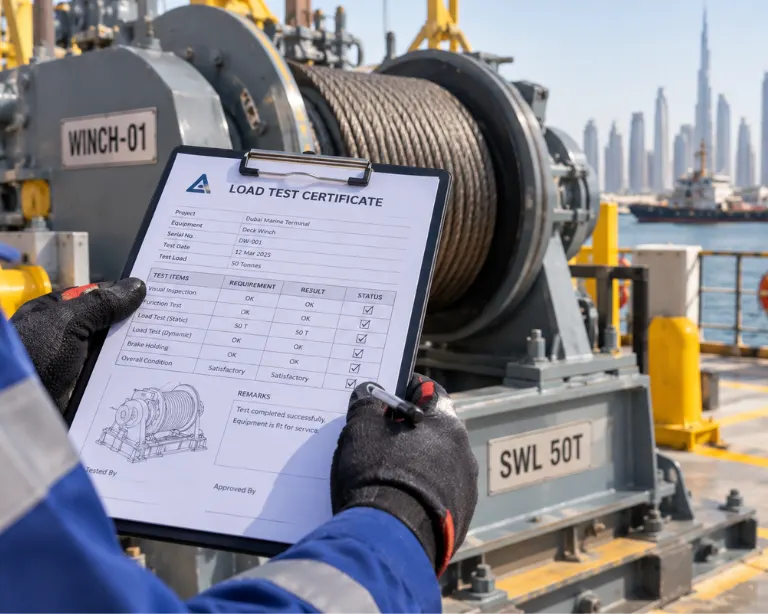
A winch that fails mid-lift on a Dubai construction site or offshore rig doesn’t fail quietly. Winch load testing exists to catch that failure before it happens, applying a controlled overload to a winch’s drum, brake, and cable system to confirm it can hold more than its rated capacity. For operators running mooring winches, construction hoists, or industrial pulling rigs across the UAE, the test decides whether equipment goes back to work or back to the shop.
Why Does Safe Working Load Compliance Matter More in UAE Conditions?
Heat is hard on winch components in this region. Motor windings degrade faster, control boards fail earlier, and brake solenoids seize up from dust and salt air working into them over months of exposure. Pneumatic systems face a similar problem: humidity gets into valves and lines, corroding parts from the inside before anyone notices a drop in pulling power. That’s the environment a safe working load rating has to hold up in, not a controlled lab.
This is why a winch that passed its last test two years ago isn’t automatically safe today. Corrosion and wear don’t announce themselves. A brake lining can be down to a fraction of its original thickness while still holding a light load just fine, right up until it doesn’t.
How the Winch Load Testing Process Actually Works
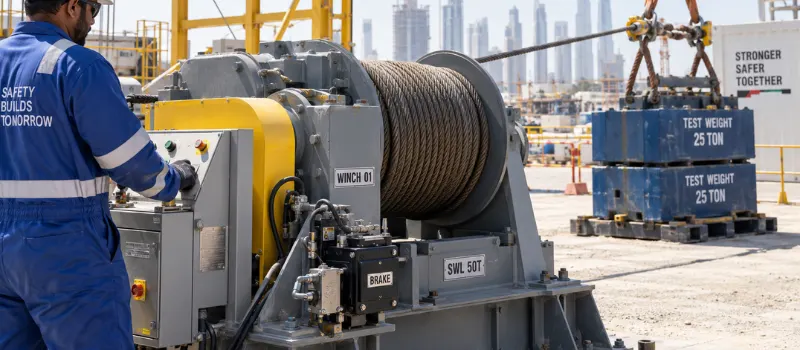
Load testing follows a structure that most rigging standards agree on, even where the exact percentages differ. A proof load test applies an overload, commonly around 125 percent of the rated capacity, to confirm the winch can handle stress beyond normal use without permanent deformation. A functional test checks that the motor, brake, and controls perform correctly at the rated load itself. These are different checks, and one doesn’t substitute for the other.
In practice, a technician rigs the winch to a calibrated load, applies it gradually, and monitors the drum, cable, and brake response throughout. The winch is swung or worked through its normal range under that load where the setup allows it. Any hesitation, slippage, or unusual noise during the test gets flagged before the load comes off, not after. If a winch fails at this stage, the fix usually starts with a proper diagnostic from a winch repair specialist who can isolate whether the fault sits in the motor, the brake assembly, or the drum itself, since these are the same components that tend to wear fastest in Gulf conditions.
Certification and Documentation Operators Need
A completed test should produce a written certificate, not just a verbal pass. That document typically records the safe working load, the actual proof load applied, the date of the test, the angle at which the load was tested if a boom or derrick was involved, and the name of the person who signed off on it. Insurers and site auditors will ask for this paperwork, and a missing or vague certificate can hold up a project faster than the winch itself ever would.
Winch operators managing several units across sites in Dubai, Sharjah, or Abu Dhabi benefit from keeping these certificates in one file rather than scattered across individual machine folders. When a client or regulator asks for proof of compliance on short notice, a disorganized record is almost as bad as no record at all.
What Operators Should Know Before Scheduling a Test
A few things affect how smoothly this goes. First, pull the winch’s repair history before booking a test. A unit with a known brake or cable issue is likely to fail, and fixing that beforehand saves a second site visit. Second, factor in downtime. A winch under test isn’t available for work, so scheduling around a project’s slower week beats pulling it mid-lift cycle. Third, confirm who is actually qualified to run the test. Not every technician who can service a winch is authorized to certify one, and the two roles aren’t interchangeable.
Finally, treat the test as one part of a maintenance rhythm, not a standalone event. A winch that gets inspected on a set schedule rarely surprises anyone at test time.
Final Thoughts
Winch load testing isn’t paperwork for its own sake. It’s the point where a machine either proves it can still do the job safely or reveals a problem before that problem shows up mid-lift. Operators who build it into a regular maintenance cycle, rather than treating it as a one-off requirement, tend to spend far less on emergency repairs down the line. When did your equipment last go through a full proof load test, and do you have the certificate to show for it?
FAQ
How often should a winch get load tested?
Most operators test annually, though heavy-use equipment in harsh conditions sometimes needs it sooner. Manufacturer guidance and any repair history should factor into the schedule. If a winch handles daily heavy pulls in a marine or offshore setting, stretching that interval isn't worth the risk.
Can a winch that fails its load test still be repaired?
Often, yes. A failed test usually points to a specific fault, a worn brake lining, a cracked hose, or a tired motor, rather than a total write-off. Once that's fixed and the unit is retested successfully, it can go back into service.
Who's actually allowed to run a load test on a winch in the UAE?
It needs to be someone trained and authorized to certify lifting equipment, not just anyone who can operate or service a winch. Ask directly whether the technician holds that specific certification before booking the work.
Does load testing replace regular winch maintenance?
No, and this trips people up. Testing confirms the winch can handle load under stress at one point in time. Maintenance, brake checks, lubrication, and cable inspection, catch the gradual wear that leads to failure between tests. You need both running on their own schedules.