Marine Engine Overheating: Causes and Quick Diagnostics
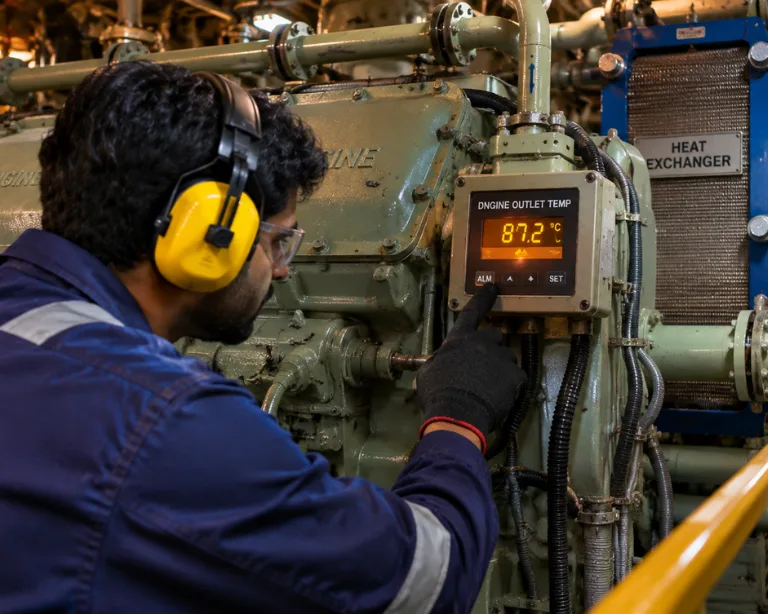
The alarm goes off, the needle is climbing, and the berth is still a long way off. Marine engine overheating nearly always starts in one of four places: raw water flow, the coolant side, the parts that move heat, or the load on the engine. Check them in that order, and you can usually narrow down the fault in minutes. Here’s a symptom-first way to do it, and the signs that mean it’s time to call an engineer for marine repair services.
The First Five Minutes After the Alarm
- Bring the throttle back to idle.
- Look at the exhaust outlet. A healthy wet exhaust pushes out a steady, pulsing stream of water. A dry, hissing, or steaming outlet means raw water isn't getting through.
- If there's little or no water, shut down. A pump running dry damages its impeller quickly, and the rubber exhaust hose can overheat.
- If the flow looks normal, idle for a few minutes, and see whether the gauge settles. Your engine manual has the final say here.
- Leave the pressure cap alone. A hot expansion tank can spray scalding coolant.
How the Cooling System Moves Heat
Most inboard diesels use two loops. The raw water pump draws seawater through the seacock and sea strainer, past the coolers and heat exchanger, and out through the exhaust mixing elbow. A separate freshwater loop carries coolant around the block and hands its heat to the seawater at the heat exchanger. Many workboats use keel coolers instead.
Reading the Symptoms: A Marine Engine Overheating Checklist
| Symptom | Likely Cause | Quick Check |
|---|---|---|
| Hot only under load | Blocked intake, worn impeller, scaled heat exchanger, fouled hull | Exhaust water at idle vs cruise, then the strainer |
| Hot at idle, fine underway | Sticking thermostat, weak impeller | Infrared reading either side of the thermostat |
| Sudden spike, no exhaust water | Closed seacock, bag on intake, failed impeller | Seacock, strainer, impeller |
| Slow creep over weeks | Scale in the heat exchanger, carbon in the mixing elbow | Temperature difference across the exchanger |
| Gauge high, engine feels normal | Faulty sender or wiring | Infrared reading vs gauge |
| Coolant loss, bubbles, white smoke | Head gasket, cracked head | Stop and call an engineer |
Raw Water Side: Check It First
It’s the easiest side to inspect, so start here.
Seacock and Sea Strainer
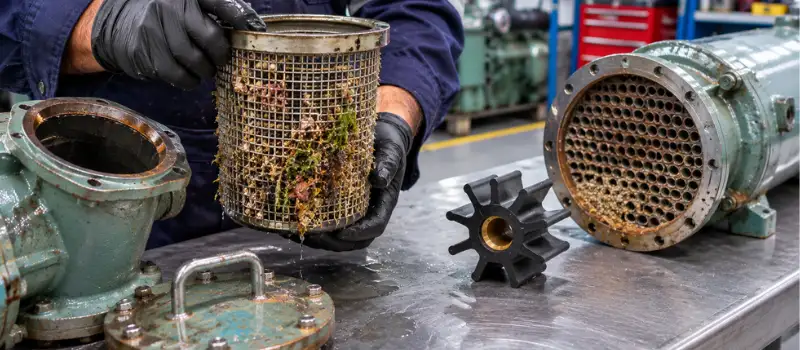
Make sure the seacock is fully open, then look into the strainer bowl. Weed, shells or, plastic can choke flow without looking obvious.
Raw Water Pump Impeller
A worn impeller still turns but moves less water, so the engine copes at idle and runs hot under load. Missing vanes travel downstream and usually lodge in the heat exchanger, so find every piece before restarting. A pump weeping at the shaft may have a worn seal.
Exhaust Mixing Elbow
On older engines, carbon and salt slowly narrow the outlet, giving a gradual temperature rise over weeks.
Coolant Side Faults
Low Coolant
Check the expansion tank with the engine cold. If the level keeps dropping and nothing reaches the bilge, there’s a leak you can’t see yet.
Thermostat and Air Locks
A thermostat stuck closed traps coolant in the block. Test it in a pan of heated water with a thermometer and see whether it opens near the temperature stamped on it. Trapped air after a coolant refill causes the same symptom, so bleed the system as the manual describes.
Combustion Gas in the Coolant
Bubbles in the tank, coolant pushed out the overflow, or hoses going rock hard soon after a cold start point to a head gasket or cracked head. Don’t keep running.
Heat Transfer and Load Problems
With an infrared thermometer, compare the coolant hose going into the heat exchanger with the one coming out. Barely any difference while the engine runs hot means heat isn’t crossing the tubes.
Sometimes the cooling system is fine and the engine is just working too hard. A fouled hull, a damaged propeller, poor engine room ventilation, or injector faults can all push temperatures up.
Is the Gauge Telling the Truth?
Compare an infrared reading at the thermostat housing with the gauge. If they disagree, test the sender’s resistance with a multimeter against the manufacturer’s chart and check for corroded ground.
When to Call a Marine Engineer
- Bubbles or exhaust gas in the coolant
- Milky engine oil
- Overheating that returns after you've checked the strainer, impeller, and thermostat
- Smoke or a burning smell near the exhaust hose
Running on regardless can warp the cylinder head, score the liners, and melt the exhaust hose, which brings a flooding risk.
Final Thoughts
Marine engine overheating usually leaves a clue: the exhaust water, when the temperature rises, or a coolant level that won’t stay put. Read those first, and the fix is often a strainer, impeller, or thermostat. When the signs point inside the engine, a qualified marine engineer, such as the team at Seven Seas Machinery in Dubai, can inspect it properly.
When did you last pull your raw water impeller and look at it?
FAQ
Why does my boat engine run hot at high speed but fine at idle?
The pump can't move enough water for the heat you're making. Check the strainer, impeller, and heat exchanger, and look at the hull and prop.
Why does it run hot at idle and cool down once I'm moving?
Often a sticking thermostat or a tired impeller that barely keeps up at low revs.
How can I tell if my raw water impeller is gone?
Weak or no exhaust water, a fast temperature climb, and torn or missing vanes when you open the pump.
Can I keep going if it's only running a little hot?
Throttle back and watch. If the gauge keeps rising or exhaust water drops off, shut down. A short wait costs far less than a cylinder head.
Can I top up coolant while the engine's still hot?
No. The tank is pressurized. Let it cool, open the cap slowly with a rag over it, then top up.